EMT Practice Test

1. Question Content...


Question List

Question1: In a Statistical Analysis Plan (SAP) the following statement is written:
To test the association between the pain intensity reported by the patient and the treatment the patient has been administered, a Cochran-Mantel-Haenszel test will be performed adjusting for the country of the patient's investigational site.
The following variables and levels are used:
- Pain intensity (PAIN): "No pain", "Mild pain", "Moderate pain", "Severe pain", "Most severe pain"
- Treatment group (TREAT): "Placebo", "Drug A", "Drug B"
- Country (COUNTRY): Eight different values.
The following program is written to perform this analysis:
proc freq data=pain;
by COUNTRY;
tables PAIN * TREAT / cmh;
run;
This code does not produce the analysis requested by the SAP.
What is wrong with this code?

Question2: Which SAS program will apply the data set label 'Demographics' to the data set named DEMO?

Question3: Which statement assigns the current date to the character variable CURRDT?

Question4: Identify the CDISC model with the following characteristics:
XML-based content and format standard facilitates the archive and interchange of the metadata and data for clinical research provides an accurate audit trail that is 21 CRF Part II compliant

Question5: Given the data set below, which SAS program correctly counts the of number of unique subjects for each combination of system organ class and treatment?

Question6: Given the following demographic dataset:

Which program will generate a report where observations will appear in order by SITE SUBJECT and display column headers for each variable defined in the column statement?

Question7: You want to calculate the p-value of Fisher's exact test for a 3x3 table.
Which option must you add to the TABLES statement of PROC FREQ?

Question8: Given the file sites.csv:

Which option would you need to add to the INFILE statement to clear the notes from this log?

Question9: The following SAS program is submitted: data WORK.ALL;

How will the data sets ONE and TWO be combined?

Question10: Given the following data set (AE):

Data will be reported by onset week. Day 1?
7 is Week 1, Day 8 ?14 is Week 2. Events beyond Day 14 are assigned Week 3 and will be reported as Follow-up events.
Which statements properly assign WEEK to each event?

Question11: What is the main focus of Good Clinical Practices (GCP)?

Question12: The following SAS program is submitted:

You want to store all calculated means and standard deviations in one SAS data set.
Which statement must be added to the program?

Question13: Which statement assigns the system date and time to the character variable CURRDTTM?

Question14: Identify the data structure with the following characteristics:
- Contains one or more records per subject, per analysis parameter, and per analysis timepoint.
- May be derived from findings, events, interventions and special-purpose SDTM domains, or other ADaM datasets.
- A record can represent an observed, derived, or imputed value required for analysis.

Question15: A Treatment-Emergent Adverse Event (TEAE) is commonly defined as any event that occurs on or after the date and time of:

Question16: The table below shows a subset of values of the variables LLTERM and HLTERM from a larger data set that is to be read into a DATA step.

Which subsetting IF statement could ensure that only records that have a missing value of LLTERM or a missing value of HLTERM are written to the resulting data set?

Question17: Which CDISC filename contains these items?
- Variable attributes
- Controlled terminology
- Computational methods

Question18: The PROC SGPLOT step below needs to be modified to format the values on the horizontal axis.
proc sgplot data = work.adlb;
histogram AVAL;
<insert code here>
run;
Which statement CANNOT be used to format the values due to a syntax error?

Question19: Given the following complete dataset (WORK.TESTDM) with the variables USUBJID (character) and AGE (numeric):

The following code is executed:
proc sql;
select age into: age separated by ','
from testdm;
quit;
What is the value of the macro variable AGE?

Question20: Which statement will create a report footnote that identifies the date and time that the SAS program was executed?

Question21: What is the primary purpose of programming validation?

Question22: By default, the PROC FREQ in the code below produces an output object named CrossTabFreqs and the PROC MEANS produces an output object named Summary.
<insert code here>
proc freq data = Work.AE;
table USUBJID*AEPTCD;
run;
proc means data = work.LB max;
class USUBJID;
var STUDYDY;
run;
Which code segment can be added prior to the PROC FREQ step to ensure that PROC MEANS produces its output object but PROC FREQ produces no output object?

Question23: The following SAS program is submitted:

What is the value of the second variable in the data set WORK.DIGESTL?

Question24: Which function would be used to determine the number of elements in an existing array?

Question25: Which CDISC model is built to harmonize information collected on case report forms?

Question26: Given two data sets with the following variables:

Why is the blue note showing in the log?

Question27: Which OPTION displays all SAS language statements generated during macro execution?

Question28: The following output is displayed:

Which SAS program created this output?

Question29: A statistical analysis plan asks you to create a table with the following counts of adverse events:
- the number adverse events in each system organ class (AESOC)
- within each level of system organ class, the number of adverse events with each preferred term (AEPT).
Which code produces the counts requested?

Question30: In CDISC, which of the following describes the usage of controlled terms, code lists, or formats?

Question31: From the Statistical Analysis Plan, patients age is calculated as an integer relative to date randomized divided by 365.25.
Given the following annotated CRF:


Which programming code defines the patient's age?

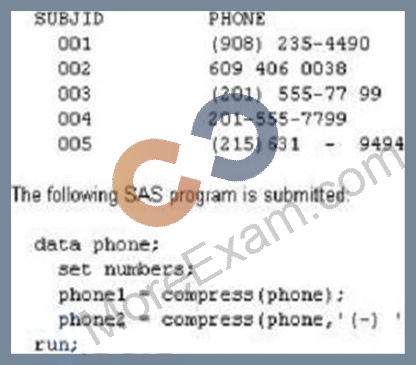
Question32: Given the SAS data set containing subject's phone numbers

What is the value of PHONE2 for subject 005?

Question33: A SAS program is submitted and the following log is written.

What is the cause of this error message?

Question34: Which LIBNAME statement is valid?

Question35: Given the full data set SUBJECT.DEMO:

The following SAS program is submitted:
%macro MP_ONE(pname=report);
proc &pname data=SUBJECT.DEMO;
run;
%mend;
%MP_ONE(print)
%MP_ONE()
Which PROC step(s), if any, execute?

Question36: A report that you are working on will require the following header lines:

Which code adds the second line of the header "Adverse Events"?

Question37: Where would you store a value collected on a case report form but not defined in an SDTM domain?

Question38: Given the following data set WORK.DM:

Which subjects will appear in the LOG file?

Question39: The following SAS program is submitted:

How many data sets are created and how many observations are in the data set(s)?

Question40: What is an international ethical and scientific quality standard for designing, conducting, recording and reporting trials that involve the participation of human subjects

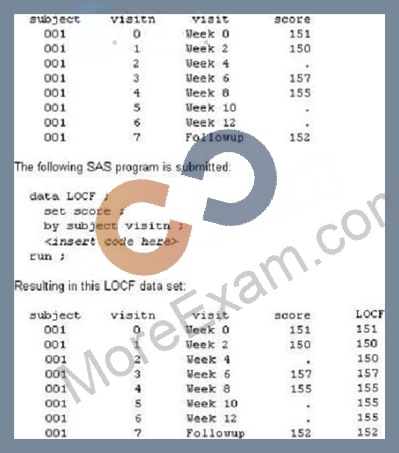
Question41: This question will ask you to provide lines of missing code.
Given the following SCORE data set:

Variable LOCF contains the imputed score that would replace the missing SCORE value (based on last observation carried forward method).
Which SAS statements complete the program?

Question42: Given the following data set:

Which program was used to prepare the data for this PROC PRINT output?

Question43: In a study, inclusion criteria required patients be between 18 and 65. Patients will be analyzed in 2 age groups: group one is subjects who are under 36 years of age and group two is subjects who are 36 years of age or older.
Which statements properly assign age group, and writes an error message to the log for any patient with an out of range age value?

Question44: A subject reports a medication started in March of 2007 but cannot recall the day number.
What is the value stored in the SDTM domain CM.CMSTDTC variable?

Question45: The print below shows the first four observations from the TEST2 dataset.
Variable names are given in the first row.

The statistical analysis plan (SAP) requests that a two sample t-test be performed to compare the mean of variable FINALBP for levels of the variable TRT.
You review the following code from a colleague:
proc ttest data=test2;
by trt;
var finalbp;
run;
This code does not produce the analysis requested by the SAP.
What is wrong with this code?

Question46: An action plan that describes what will be done in a drug study, how it will be conducted, and why each part of the study is necessary is called:

Question47: The following SAS program is submitted:
%let Av=age;
%macro LABD(Av=weight);
%let Av=gend; %mend;
%LABD(Av=height)
%put Av is &Av;
What will be written to the SAS log?

Question48: The VISIT data set is multiple records per subject, sorted by usubjid vistdtc vistm and contains the following variables:

The DEATH data set is one record per subject, sorted by usubjid vistdtc vistm and contains the following variables:

Which program will combine the DEATH and VISIT data sets by matching records?

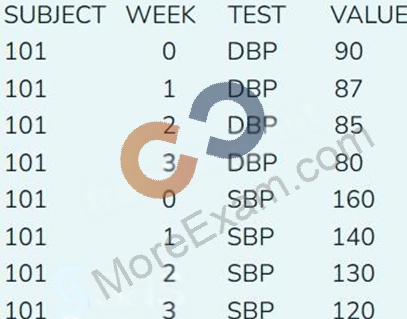
Question49: Given the data set RAWBP that is sorted by SUBJECT TEST WEEK:

Baseline is defined as the week 0 value. Your colleague provides the following SAS program to calculate change from baseline:
data bp;
set rawbp;
by subject test week;
retain baseline;
if first.subject then baseline = value;
if week > 0 then change = value - baseline;
run;
What does the code calculate as the change from baseline for systolic blood pressure (SBP) at week 3?

Question50: This question will ask you to provide a section of missing code.
Given the input SAS data set LABRAW:

Which DO LOOP will create the output SAS data set WORK.LAB_NEW?

Question51: The following partial output was produced from the SAS Dictionary Tables.

Which SQL statement produced this output?

Question52: The following SAS program is submitted:
proc univariate date=work.STUDY; by VISIT; class REGION TREAT; var HBA1C GLUCOS; run; You want to store all calculated means and standard deviations in one SAS data set.
Which statement must be added to the program?

Question53: This question will ask you to provide a line of missing code.
Given the following log entry:

Which line of code would produce the merge issue notes in the log?

Question54: Which option for PROC COMPARE will list all observations and variables found in only one of the two data sets being compared?

Question55: A Statistical Analysis Plan defines study day as the number of days between the visit date and the date of randomization plus one day.
The following SAS program is submitted using a macro from the project's library:

How is the STUDYDAY macro defined?

Question56: This question will ask you to provide a line of missing code. Given the data set RAWBP that is sorted by SUBJECT TEST WEEK:

The following SAS program is submitted:
data bp;
set rawbp;
by subject test week;
retain baseline;
if first.test then baseline = .;
if week = 0 then baseline = value;
else if week > 0 then do;
<insert code here>
end;
run;
Which statement must be added to the program to calculate percent change from baseline?

Question57: This question will ask you to provide a line of missing code.

Which statement must be added to the following program to create a page break in the report after each RACE grouping?

Question58: Which of these tasks is NOT required for a validating programmer to state that an output has been independently validated using double programming once a PROC COMPARE has been run and shows the output electronically validates?

Question59: What information can be found in the SAS Dictionary tables? There are two correct answer, Please select two correct answer.

Question60: Review the following procedure format:
PROC TTEST date=date;
class group-variable;
var variable;
run;
What is the required type of data for the variable in this procedure?

Question61: A Statistical Analysis Plan (SAP) defines the selection process for baseline records. This instructs the programmer to choose the last non-missing analyte value prior to first study drug administration (date/time).
The DEMO data set contains the date/time of first study drug administration for subject:

What will be the resulting baseline values, as selected per the SAP instructions?

Question62: You are working with the VS data set that contains the variable Pulse.

Which PROC SGPLOT step will produce the graph shown below?